The real cost of a return for online sellers (and how to calculate it)
A return on a $50 order can cost you $18 or more: fees the platform keeps, shipping both ways, and items you can't resell. Here's the formula and how to lower it.
By Sharjil Hameed · Published November 19, 2026 · Last reviewed November 24, 2026 · 3 min read · How we fact-check

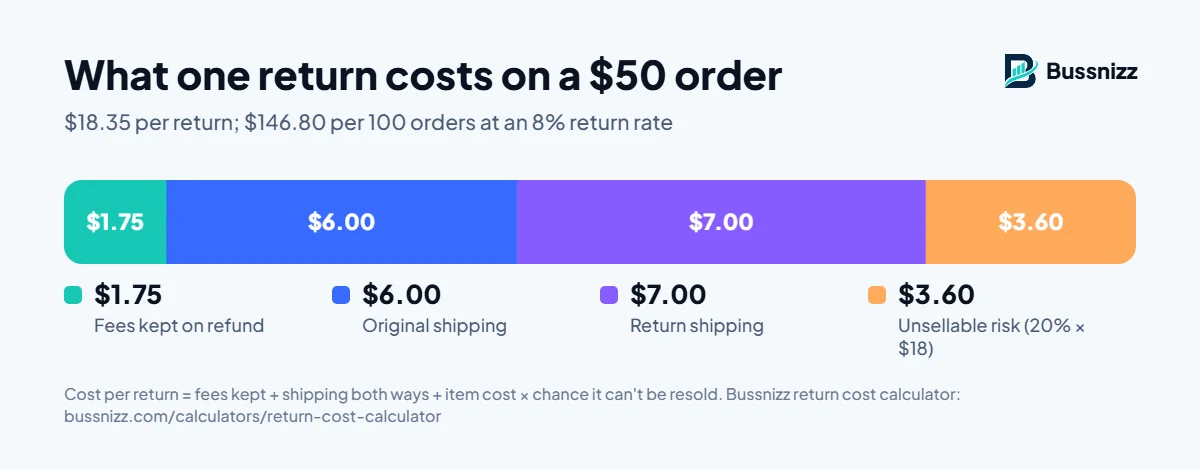
Short answer: cost per return = fees the platform keeps on the refund + shipping both ways + item cost × the chance it can’t be resold. On a $50 order with $1.75 in kept fees, $6 original shipping, $7 return shipping and an $18 item with a 20% chance of being unsellable, each return costs $18.35. At an 8% return rate, that’s $146.80 for every 100 orders. Work out yours with the return cost calculator.
What the return cost calculator does
The return cost calculator adds up everything a refund costs you, then scales it by your return rate to show the cost per 100 orders and as a share of order value. It turns a vague worry (“returns are eating my profit”) into a number you can price for.
How it works
- Cost per return = fees kept + original shipping + return shipping + (item cost × chance it can’t be resold)
- Cost per 100 orders = cost per return × return rate × 100
Worked example
| Cost | Amount |
|---|---|
| Fees the platform keeps on refund | $1.75 |
| Original shipping you paid | $6.00 |
| Return shipping you pay | $7.00 |
| Item cost × 20% chance it can’t be resold | $3.60 |
| Cost per return | $18.35 |
That’s 36.7% of the $50 order value, and at an 8% return rate, $146.80 per 100 orders, or about $1.47 on every order you ship.
Which fees do platforms keep on refunds?
It varies, and it changes. Some platforms refund their percentage fee but keep fixed fees or payment processing. Check your platform’s refund policy and enter the fee you actually lose. Our fee guides for Etsy, eBay, Amazon FBA and Stripe explain each platform’s charges.
How to lower the cost of returns
- Better listings: measurements, materials, real-life photos and a size chart prevent “not as described” returns.
- Careful packing to cut damage returns.
- Clear return policy: who pays return shipping, and the return window.
- Inspect and restock fast so returned items are resold at full price.
- Price for returns: add your cost per order (here $1.47) into your price for categories with high return rates.
Options in the calculator
- Order value, fees kept on refund, original shipping, return shipping, item cost, chance it can’t be resold, your return rate
Why use this calculator
- Counts the hidden pieces, like outbound shipping and unsellable stock, that a simple refund total misses.
- Per-100-orders view so you can build returns into your price.
- Free, private and printable.
Conclusion
Every return costs more than the refund. Know your cost per return, multiply by your return rate, and either reduce returns or price them in.
Frequently asked questions
How do I calculate the cost of a return? Add fees you don’t get back, shipping both ways, and the item cost multiplied by the chance it can’t be resold.
Do I get marketplace fees back when I refund? Partly, on most platforms; fixed and processing fees are often kept. Check your platform’s policy.
What is a normal return rate for online sellers? It varies a lot by category; clothing and shoes are typically much higher than home goods or handmade items. Use your own data.
Should I offer free returns? Only if you’ve priced them in. Use the cost per 100 orders to see what free returns would cost.
How do I include returns in my price? Divide your cost per 100 orders by 100 and add it to your cost per sale.
Example figures are illustrative. Enter your own fees and return rate for an accurate result.
Run the numbers yourself
Free calculators with every fee and formula shown.
 Etsy Profit CalculatorWhat you keep after Etsy's listing, transaction, processing, and Offsite Ads fees, for sellers in 7 countries.
 Amazon FBA Profit CalculatorProfit per unit on Amazon FBA after referral fees, fulfillment, storage, PPC, and your selling plan.
Marketplace Profit CompareOne product, seven platforms: see what you keep after fees on Etsy, eBay, Amazon, Walmart, TikTok Shop, Shopify and WooCommerce, ranked, with every rate editable.
 eBay Fee CalculatoreBay final value fees, the per-order fee, international and promoted listing fees, and your profit.
Profit Margin CalculatorGross profit, margin, and markup from cost and price.