How to calculate markup: the formula, a markup vs margin chart, and examples
Markup is profit as a share of cost; margin is profit as a share of price. Here's the markup formula, a conversion chart, and how to price from cost without underpricing.
By Sharjil Hameed · Published November 19, 2026 · Last reviewed November 24, 2026 · 3 min read · How we fact-check
Short answer: markup = (price − cost) ÷ cost, and selling price = cost × (1 + markup). An item that costs you $20 with a 40% markup sells for $28. If you want a 40% margin instead, the price is cost ÷ (1 − 0.40) = $33.33, which is a 66.7% markup. Try both with the free markup calculator.
What the markup calculator does
The markup calculator turns a cost into a selling price. You choose whether to price by markup (how much you add on top of cost) or by margin (how much of the price you keep), and it shows the selling price, profit per unit, and the matching markup or margin. Add a quantity to see totals for a whole order or batch.
It’s built for sellers who price from cost: handmade makers, resellers, dropshippers, wholesalers and anyone setting a price list.
How markup is calculated
There are two formulas, depending on what you know:
- Price from markup: price = cost × (1 + markup %)
- Price from margin: price = cost ÷ (1 − margin %)
And to work backward from a price you already charge:
- Markup % = (price − cost) ÷ cost × 100
- Margin % = (price − cost) ÷ price × 100
Worked example
Your product costs $20 (materials, packaging and your landed cost).
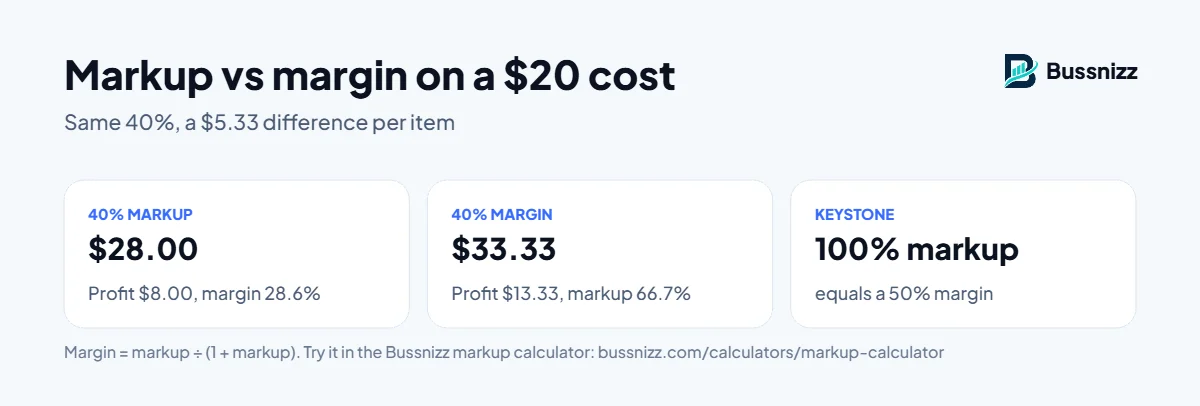
- By markup, 40%: $20 × 1.40 = $28.00. Profit $8.00. Margin 28.6%.
- By margin, 40%: $20 ÷ 0.60 = $33.33. Profit $13.33. Markup 66.7%.
Same “40%”, a $5.33 difference per item. On 500 sales a year that’s $2,665, which is why it matters which one you mean.
Markup vs margin chart
| Markup | Margin | Price for a $10 cost |
|---|---|---|
| 25% | 20.0% | $12.50 |
| 33.3% | 25.0% | $13.33 |
| 50% | 33.3% | $15.00 |
| 66.7% | 40.0% | $16.67 |
| 100% (keystone) | 50.0% | $20.00 |
| 150% | 60.0% | $25.00 |
| 200% | 66.7% | $30.00 |
To convert: margin = markup ÷ (1 + markup) and markup = margin ÷ (1 − margin).
Options in the calculator
- Cost: what one unit costs you. Include materials, packaging and inbound shipping.
- Price by: markup or margin.
- Percent: your markup or target margin.
- Quantity: optional, for totals across many units.
Why use this calculator
- It shows both numbers at once, so you never confuse a 50% markup with a 50% margin.
- No sign-up and nothing stored. The math runs in your browser.
- Share or print the result. The print button saves a clean one-page report with your inputs and price.
- It connects to fees. Markup on cost doesn’t include marketplace fees. Once you have a price, check what you really keep in the Etsy profit calculator, eBay fee calculator or Amazon FBA calculator.
Common markup mistakes
- Forgetting fees. A 100% markup on a $10 item sold on Etsy for $20 leaves less than $10 profit once about $2.35 in Etsy fees come out (listing, transaction and processing).
- Leaving out your time. For handmade work, labor is a cost. The true hourly earnings calculator shows what your price pays per hour.
- Using markup and margin interchangeably with suppliers or retailers. Always say which one you mean.
Conclusion
Markup tells you how far above cost you price; margin tells you how much of each sale you keep. Price with whichever your business plans in, but check the other number too, and always check the price against platform fees before you list.
Frequently asked questions
What is the formula for markup? Markup % = (selling price − cost) ÷ cost × 100. To set a price, multiply cost by (1 + markup).
What is a good markup for retail? Many retailers use keystone pricing, a 100% markup (50% margin), as a starting point. The right number depends on your fees, returns and competition.
How do I calculate a 30% markup? Multiply cost by 1.30. A $15 cost becomes $19.50.
Is a 50% markup the same as a 50% margin? No. A 50% markup on $10 is $15 (33.3% margin). A 50% margin on $10 is $20 (100% markup).
How do I find the markup from price and cost? Subtract cost from price, divide by cost, and multiply by 100. $30 price, $12 cost: ($30 − $12) ÷ $12 = 150%.
Formulas are standard; examples use round numbers. Use the markup calculator with your real costs, and the profit margin guide for more on margin.
Run the numbers yourself
Free calculators with every fee and formula shown.
 Etsy Profit CalculatorWhat you keep after Etsy's listing, transaction, processing, and Offsite Ads fees, for sellers in 7 countries.
 Amazon FBA Profit CalculatorProfit per unit on Amazon FBA after referral fees, fulfillment, storage, PPC, and your selling plan.