Should you run a sale? How many more sales a discount needs to break even
A 20% discount can double the sales you need just to earn the same profit. Here's the formula, a worked example, and how to discount without losing money.
By Sharjil Hameed · Published November 19, 2026 · Last reviewed November 24, 2026 · 3 min read · How we fact-check

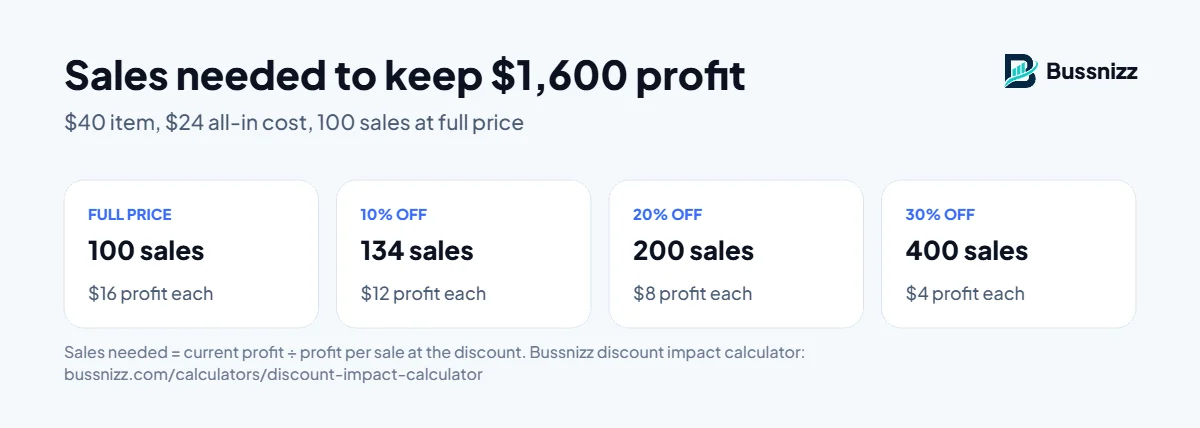
Short answer: sales needed at the discount = (profit per sale now × current sales) ÷ profit per sale at the discount. If you sell a $40 item that costs you $24 all-in, a 20% discount cuts profit per sale from $16 to $8, so you need 200 sales instead of 100 just to earn the same profit. Test any discount with the discount impact calculator.
What the discount impact calculator does
The discount impact calculator shows how many sales a promotion has to generate before it earns you as much as you make now. It’s the check to run before a holiday sale, a coupon code, or an Etsy or Shopify discount.
How it works
- Profit per sale now = price − cost per sale
- Profit per sale on sale = price × (1 − discount) − cost per sale
- Sales needed = (profit now × current sales) ÷ profit on sale
- Extra sales = sales needed − current sales
“Cost per sale” should be all-in: product, packaging, shipping you pay, and marketplace and payment fees.
Worked example
- Normal price: $40, all-in cost: $24 → profit $16
- Discount: 20% → price $32, profit $8
- Current sales: 100 → profit $1,600
- To earn $1,600 at $8 each: 200 sales, which is +100%
Halving profit per sale means doubling sales. That’s why a discount that “feels small” on price can be huge on profit.
The discount rule of thumb
The thinner your margin, the more a discount hurts. If your profit is 40% of the price, a 20% discount removes half of it. If your profit is only 25%, a 20% discount removes 80% of it, and you need five times the sales.
Smarter ways to discount
- Discount for a reason (a launch, a restock, clearing old stock), not by default.
- Use thresholds: “15% off orders over $60” raises order value while discounting.
- Bundle instead: a set at a small saving protects margin better than a percentage off one item.
- Offer free shipping above a minimum and price it into the item.
- Check fees on the discounted price. Marketplace fees are a percentage of the lower price, so they shrink slightly, but fixed fees don’t.
Options in the calculator
- Normal price, cost per sale (all-in), discount %, sales you make now
Why use this calculator
- Answers the real question, “how many more sales do I need?”, in one step.
- Free and private, with a print-ready report to share with a partner before a promotion.
- Linked to margin and break-even tools to check the rest of your pricing.
Conclusion
Run the numbers before every sale. If you can’t realistically get the extra orders, use a smaller discount, a threshold, or a bundle instead.
Frequently asked questions
How do I calculate the impact of a discount on profit? Compare profit per sale before and after the discount, then divide your current total profit by the new profit per sale.
How many more sales do I need to offset a 10% discount? It depends on your margin. With a $40 price and $24 cost, 10% off cuts profit from $16 to $12, so you need 134 sales instead of 100 (+34).
Is a discount ever worth it? Yes, when it brings new customers who come back, clears stock that would otherwise cost you storage, or lifts order value.
Should I include marketplace fees in cost per sale? Yes. Use the Etsy, eBay or Amazon calculators to find them.
What happens if the discount is bigger than my profit? You lose money on every discounted sale, and the calculator will say so.
Examples use round numbers. Use your own all-in cost per sale for an accurate answer.
Run the numbers yourself
Free calculators with every fee and formula shown.
 Etsy Profit CalculatorWhat you keep after Etsy's listing, transaction, processing, and Offsite Ads fees, for sellers in 7 countries.
 Amazon FBA Profit CalculatorProfit per unit on Amazon FBA after referral fees, fulfillment, storage, PPC, and your selling plan.