How to calculate net profit and net profit margin, step by step
Net profit = revenue − cost of goods − operating expenses − interest − taxes. Here's the calculation step by step, net margin, and what a healthy number looks like.
By Sharjil Hameed · Published November 19, 2026 · Last reviewed November 24, 2026 · 2 min read · How we fact-check

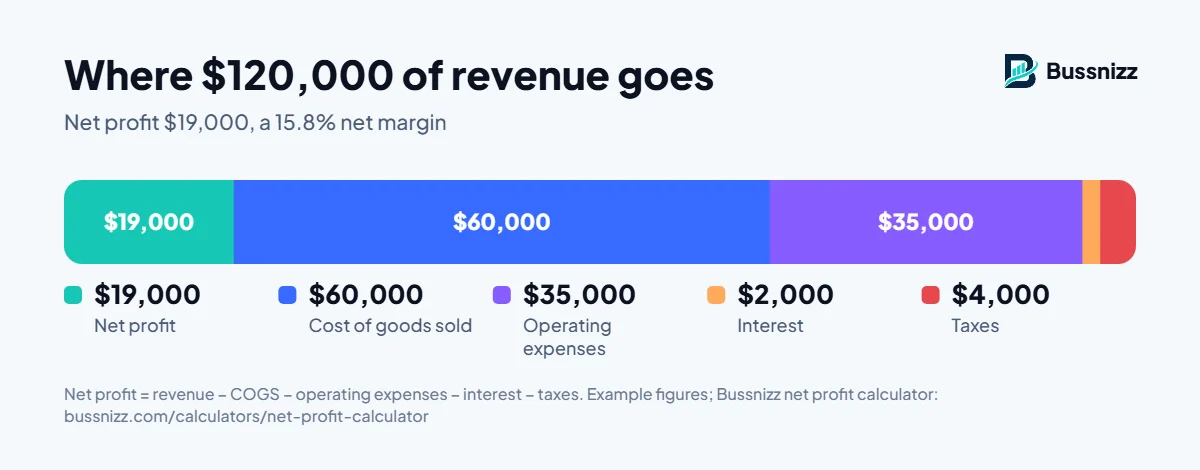
Short answer: net profit = revenue − cost of goods sold − operating expenses − interest − taxes. A business with $120,000 in revenue, $60,000 in cost of goods, $35,000 in operating expenses, $2,000 in interest and $4,000 in taxes has a net profit of $19,000, a 15.8% net profit margin. Check yours in the net profit calculator.
What the net profit calculator does
The net profit calculator takes the five lines of a simple income statement and gives you net profit, net profit margin and operating profit. It’s the “bottom line”: what’s left after every cost, including the ones that don’t feel like costs until tax time.
How net profit is calculated
- Gross profit = revenue − cost of goods sold (COGS)
- Operating profit = gross profit − operating expenses
- Net profit = operating profit − interest − taxes
- Net profit margin = net profit ÷ revenue × 100
Worked example
| Line | Amount |
|---|---|
| Revenue | $120,000 |
| Cost of goods sold | −$60,000 |
| Gross profit | $60,000 |
| Operating expenses | −$35,000 |
| Operating profit | $25,000 |
| Interest | −$2,000 |
| Taxes | −$4,000 |
| Net profit | $19,000 |
Net profit margin = $19,000 ÷ $120,000 = 15.8%. For every $100 of sales, the business keeps $15.80.
What goes in each line for an online seller
- Revenue: everything buyers paid you, including shipping you charged. Leave out sales tax the marketplace collected on your behalf.
- Cost of goods sold: product cost, materials, packaging and inbound freight for the items you sold.
- Operating expenses: marketplace and payment fees, ads, software, shipping labels, rent, contractors. See the operating expenses guide.
- Interest: on loans or business credit cards.
- Taxes: income tax on the business’s profit.
Marketplace fees are easy to undercount. On Etsy, fees take about 10.6% of a typical US order before ads (Etsy fees explained).
Options in the calculator
- Revenue, cost of goods sold, operating expenses, interest, taxes. Enter yearly or monthly figures, as long as they cover the same period.
Why use this calculator
- It shows the steps, gross to operating to net, so you can see which layer is eating your profit.
- Free, private and printable. Save a one-page report for your records or your accountant.
- Linked tools for each layer: gross profit, operating expenses and profit margin.
What is a good net profit margin?
It depends on the business model. Resellers with low prices and high volume often run thin net margins; handmade and digital products can run much higher. Track your own margin month to month: a falling margin with rising sales usually means fees, ads or shipping are growing faster than revenue.
Conclusion
Net profit is the number that pays you. Calculate it monthly, compare it with gross profit, and look hardest at the layer that changed most.
Frequently asked questions
What is the formula for net profit? Net profit = revenue − cost of goods sold − operating expenses − interest − taxes.
How do I calculate net profit margin? Divide net profit by revenue and multiply by 100.
What is the difference between gross profit and net profit? Gross profit only subtracts the cost of the goods you sold. Net profit subtracts every cost. See gross profit vs net profit.
Is net profit the same as net income? In everyday small-business use, yes: both mean the bottom line after all expenses and taxes.
Do marketplace fees count as COGS or operating expenses? Many sellers record them as operating expenses (selling costs). Be consistent and ask your accountant how to report them.
This guide explains the math, not tax rules. For tax treatment, see the IRS guide to deducting business expenses or ask a tax professional.
Run the numbers yourself
Free calculators with every fee and formula shown.
 Etsy Profit CalculatorWhat you keep after Etsy's listing, transaction, processing, and Offsite Ads fees, for sellers in 7 countries.
 Amazon FBA Profit CalculatorProfit per unit on Amazon FBA after referral fees, fulfillment, storage, PPC, and your selling plan.