Operating expenses: the formula, examples, and your OpEx ratio
Operating expenses are the costs of running the business that aren't product costs. Here's the formula, what to include, a worked example, and the OpEx ratio.
By Sharjil Hameed · Published November 19, 2026 · Last reviewed November 24, 2026 · 2 min read · How we fact-check

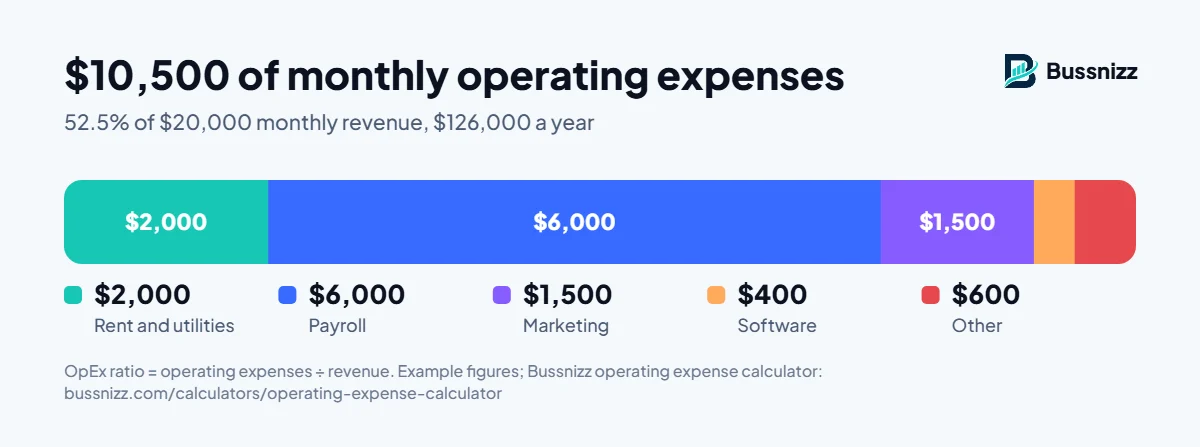
Short answer: operating expenses = the sum of your running costs that aren’t cost of goods sold, such as rent, payroll, marketing and software. The OpEx ratio = operating expenses ÷ revenue. A business with $20,000 in monthly revenue and $10,500 in operating expenses has an OpEx ratio of 52.5%. Add yours up in the operating expense calculator.
What the operating expense calculator does
The operating expense calculator totals your monthly overhead by category and shows monthly operating expenses, the share of revenue they take, and the yearly total. It makes a scattered list of bills into one number you can manage.
The operating expenses formula
- Operating expenses = rent and utilities + payroll + marketing + software and subscriptions + other overhead
- OpEx ratio = operating expenses ÷ revenue × 100
- Operating profit = gross profit − operating expenses
What counts as an operating expense for an online seller
- Rent and utilities: a studio, storage unit or home-office share
- Payroll and contractors: staff, virtual assistants, photographers
- Marketing: Etsy Ads, Amazon PPC, social ads, influencer fees
- Software and subscriptions: Shopify or Etsy Plus plans, email tools, design apps
- Other: insurance, bank fees, accounting, phone
What usually isn’t OpEx: product cost and materials (that’s cost of goods sold), loan principal, and income tax.
Worked example
| Category | Monthly |
|---|---|
| Rent and utilities | $2,000 |
| Payroll | $6,000 |
| Marketing | $1,500 |
| Software and subscriptions | $400 |
| Other | $600 |
| Total operating expenses | $10,500 |
With $20,000 in monthly revenue, the OpEx ratio is 52.5%, or $126,000 a year. If gross margin is 60%, operating profit is $12,000 − $10,500 = $1,500 a month. Thin, so the next step is finding the biggest line that can shrink.
How to lower your operating expenses
- Audit subscriptions every quarter. Small monthly tools add up.
- Measure ad spend against profit, not revenue. Ads are only worth it if each sale’s profit covers its ad cost.
- Batch work like photography and listing to reduce contractor hours.
- Recheck platform plans when sales change. A plan that made sense at 500 orders a month may not at 100.
Options in the calculator
- Monthly revenue
- Rent and utilities, payroll, marketing, software and subscriptions, other
Why use this calculator
- One number for overhead, plus the share of revenue it takes.
- Free, private and printable for budgeting meetings or your bookkeeper.
- Connected to profit: feed the total into the net profit calculator or use it as fixed costs in the break-even calculator.
Conclusion
Operating expenses decide how much of your gross profit you keep. Total them monthly, watch the ratio, and cut from the biggest category first.
Frequently asked questions
What is the formula for operating expenses? Add up all running costs that aren’t cost of goods sold: rent, payroll, marketing, software and other overhead.
What is a good operating expense ratio? It varies by industry. A lower ratio means more of each sale is left as operating profit; track yours over time.
Are marketplace fees operating expenses? Many sellers record them as selling expenses within operating expenses. Be consistent.
Is cost of goods sold an operating expense? No. COGS is subtracted first to get gross profit; operating expenses come after.
How do I calculate operating profit? Operating profit = gross profit − operating expenses.
For which expenses are tax-deductible, see the IRS guide to deducting business expenses.
Run the numbers yourself
Free calculators with every fee and formula shown.
 Etsy Profit CalculatorWhat you keep after Etsy's listing, transaction, processing, and Offsite Ads fees, for sellers in 7 countries.
 Amazon FBA Profit CalculatorProfit per unit on Amazon FBA after referral fees, fulfillment, storage, PPC, and your selling plan.