Sales tax for online sellers in the US: how to add or remove it, and who collects it
Total = price × (1 + rate), and price before tax = total ÷ (1 + rate). Here's how to calculate sales tax, and why Etsy, Amazon and eBay usually collect it for you.
By Sharjil Hameed · Published November 19, 2026 · Last reviewed November 24, 2026 · 3 min read · How we fact-check
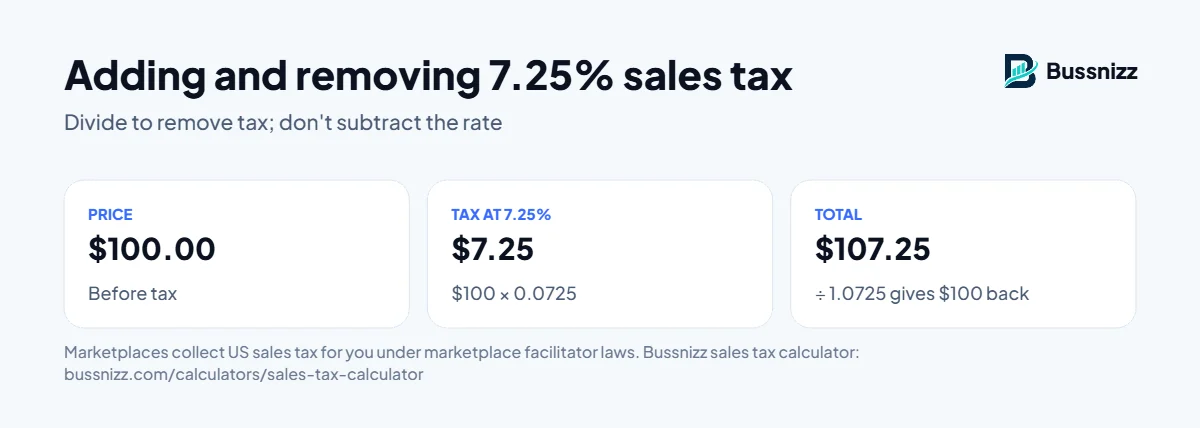
Short answer: to add sales tax, total = price × (1 + tax rate); to remove it, price before tax = total ÷ (1 + tax rate). A $100 item at 7.25% totals $107.25. When you sell on Etsy, Amazon, eBay, Walmart or TikTok Shop, the marketplace usually collects and sends the sales tax for you under marketplace facilitator laws. On your own Shopify or WooCommerce store, that’s your job. Add or remove tax with the sales tax calculator.
What the sales tax calculator does
The sales tax calculator adds tax to a price or takes it out of a tax-included total, and shows the tax amount. It’s handy for quoting prices, checking receipts, and working out your pre-tax revenue from a total.
How to calculate sales tax
- Add tax: tax = price × rate; total = price + tax
- Remove tax: price = total ÷ (1 + rate); tax = total − price
A common mistake when removing tax is to subtract the rate from the total: 7.25% of $107.25 is $7.78, not the $7.25 that was actually added.
Worked example
- Adding: $100 × 7.25% = $7.25 tax → $107.25
- Removing: $107.25 ÷ 1.0725 = $100.00 before tax
Who collects sales tax when you sell online?
Marketplaces. Every US state with a statewide sales tax has a marketplace facilitator law, so platforms like Etsy, Amazon, eBay and Walmart calculate, collect and send sales tax on orders they process. You usually don’t add it to your price, and it doesn’t count as your revenue.
Your own store. On Shopify, WooCommerce or Square, you’re responsible. Since the Supreme Court’s 2018 decision in South Dakota v. Wayfair, states can require out-of-state sellers to collect once they pass an “economic nexus” threshold, which in many states is $100,000 in annual sales into that state. You must also collect in states where you have a physical presence.
No statewide sales tax: Alaska, Delaware, Montana, New Hampshire and Oregon. Alaska allows local sales taxes.
Sales tax and your profit
Marketplace-collected tax isn’t your money and shouldn’t be in revenue. But payment processing is often charged on the full amount the buyer pays, including tax. Etsy, for example, charges its 3% + $0.25 processing on the total, so tax slightly raises your fees. See Etsy fees explained.
Options in the calculator
- Mode: add tax or remove tax
- Amount, sales tax rate
Why use this calculator
- Both directions in one place, with the correct formula for removing tax.
- Free and private, with a printable result.
- Selling outside the US? Use the VAT and GST calculator.
Conclusion
The math is simple; the rules are the hard part. On marketplaces, let the platform handle collection and keep tax out of your revenue. On your own store, track where you have nexus and register before you collect.
Frequently asked questions
How do I calculate sales tax? Multiply the price by the tax rate. Add it to the price for the total.
How do I remove sales tax from a total? Divide the total by (1 + the rate). $107.25 ÷ 1.0725 = $100.
Do Etsy and Amazon collect sales tax for me? In the US, yes: marketplace facilitator laws require them to collect and remit sales tax on sales they process.
Which states have no sales tax? Alaska, Delaware, Montana, New Hampshire and Oregon have no statewide sales tax.
Is sales tax part of my revenue? Tax you collect on behalf of a state isn’t your income. Ask a tax professional how to record it.
This guide is general information, not tax advice. Rules change and vary by state; see the SBA’s tax guidance for small businesses or a tax professional.
Run the numbers yourself
Free calculators with every fee and formula shown.
 Etsy Profit CalculatorWhat you keep after Etsy's listing, transaction, processing, and Offsite Ads fees, for sellers in 7 countries.
Marketplace Profit CompareOne product, seven platforms: see what you keep after fees on Etsy, eBay, Amazon, Walmart, TikTok Shop, Shopify and WooCommerce, ranked, with every rate editable.
 Amazon FBA Profit CalculatorProfit per unit on Amazon FBA after referral fees, fulfillment, storage, PPC, and your selling plan.
 eBay Fee CalculatoreBay final value fees, the per-order fee, international and promoted listing fees, and your profit.