Amazon FBA Fee Changes 2027: What Sellers Will Pay
Amazon FBA fee changes 2027 start Jan. 15: fees rise $0.19 per unit on average, and small items over $50 pay $0.70 more. See the new rates and what to do.
By Sharjil Hameed · Published November 25, 2026 · 5 min read · How we fact-check
Short answer: The Amazon FBA fee changes for 2027 start on January 15, 2027. Fulfillment fees rise by $0.19 per unit on average, but small standard-size items priced over $50 pay $0.70 more on average. The 3.5% fuel and logistics surcharge stays. Run your products through our Amazon FBA profit calculator to see your new margin.
Amazon announced its 2027 US fee schedule on November 5, 2026. Most fulfillment changes apply to units that ship on or after January 15, 2027, the day after the 2026 holiday peak fees end. Storage and low-inventory changes follow on February 1, 2027. Below is what changes, which sellers pay more, and what to do before January.
What are the Amazon FBA fee changes for 2027?
Amazon says FBA fulfillment fees will go up by $0.19 per unit sold on average, which it puts at about 0.8% of the average item’s selling price. That average hides a wide spread. Amazon’s own summary breaks it down like this:
- Priced $10 to $50: small standard-size fees rise $0.40 per unit on average; large standard-size fees rise $0.12.
- Priced above $50: small standard-size fees rise $0.70 per unit on average; large standard-size fees rise $0.47.
- Priced below $10: small standard-size fees rise $0.20 on average. Large standard-size non-apparel fees stay the same; large standard-size apparel rises $0.08.
- Fuel and logistics surcharge: unchanged at 3.5% of fulfillment fees. Amazon introduced it in April 2026, and the 2027 rate card prices do not include it.
- Bulky and oversize: Amazon is replacing the current bulky and extra-large tiers with new size tiers. Some large, heavy items get cheaper and some very long or flat items pay more.
How much is the FBA fee per unit in 2027?
Here are sample rows from Amazon’s non-peak rate card for non-apparel items. The 2026 column is the January 15 to October 14, 2026 rate. The 2027 column applies from January 15 to October 14, 2027. Neither includes the 3.5% surcharge.
| Size tier and shipping weight | $10 to $50: 2026 | $10 to $50: 2027 | Above $50: 2026 | Above $50: 2027 |
|---|---|---|---|---|
| Small standard, 2+ to 4 oz | $3.42 | $3.78 | $3.68 | $4.34 |
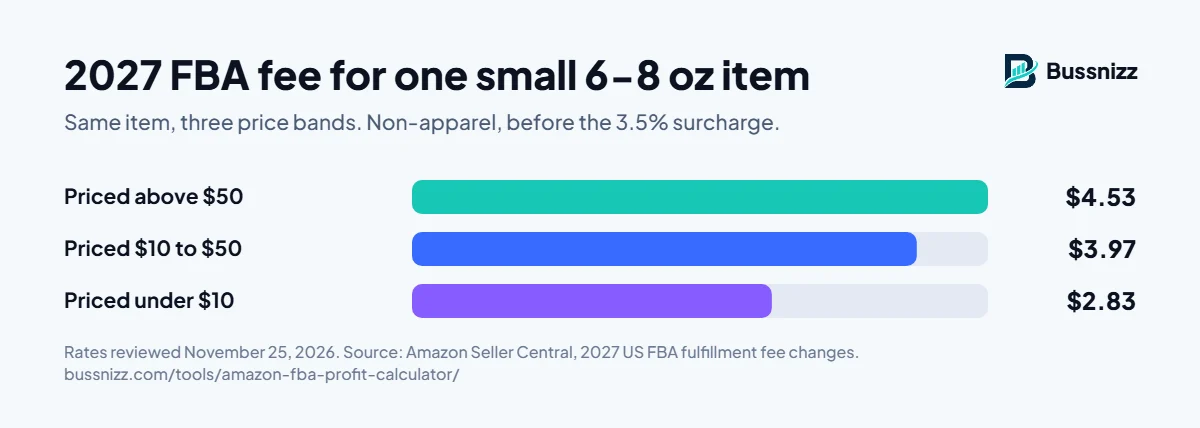
| Small standard, 6+ to 8 oz | $3.54 | $3.97 | $3.80 | $4.53 |
| Small standard, 14+ to 16 oz | $3.96 | $4.32 | $4.22 | $4.88 |
| Large standard, 1+ to 1.25 lb | $5.04 | $5.19 | $5.30 | $5.75 |
| Large standard, 2.75+ to 3 lb | $6.67 | $6.85 | $6.93 | $7.41 |
The pattern is clear. Light, small items take the biggest jumps, and the extra cost of pricing above $50 grows. For a small standard item at 6+ to 8 oz, the gap between the $10 to $50 band and the above-$50 band was $0.26 in 2026 ($3.80 minus $3.54). In 2027 it is $0.56 ($4.53 minus $3.97).
Why do items over $50 pay more for FBA?
Amazon says the higher above-$50 rates fund service improvements for those products, such as returns handling, fewer missing units and faster removals. Whatever the reason, the band edge now matters for pricing. Amazon’s FAQ says items priced at exactly $10 or exactly $50 get the $10 to $50 rates.
So a small standard item weighing 2+ to 4 oz pays $3.78 at a $50.00 price and $4.34 at $50.01, before the surcharge. If your product sits just above $50, test whether $49.99 or $50.00 earns you more after fees. Our profit margin calculator makes that comparison quick.
Which products lose low-price FBA rates in 2027?
Today, all products priced under $10 automatically get low-price FBA rates. From January 15, 2027, Amazon is narrowing that to fewer fee categories. Products in these five fee categories will be charged the $10 to $50 rates instead:
- Automotive and Powersports
- Compact Appliances
- Computers
- Musical Instruments and AV Production
- Media: Books, DVD, Music, Software, Video
For a cheap, light item this is the largest change in the schedule. On Amazon’s rate card, a small standard item at 2+ to 4 oz pays $2.72 at the 2027 under-$10 rate but $3.78 at the $10 to $50 rate. That is $1.06 more per unit for a seller in one of these categories. Every other fee category keeps low-price rates automatically.
What else changes in 2027: storage, low-inventory and promotion fees
- Storage (February 1, 2027): Amazon is removing the storage utilization surcharge and the aged inventory surcharge, and folding them into one age-based monthly storage rate. Amazon says this means flat or lower fees for inventory that sells within six months, and higher fees for aged inventory.
- Low-inventory-level fee (February 1, 2027): the fee will apply only when inventory falls below 28 days of supply based on actual shipments in both the four weeks before and the four weeks after the check. Today it uses trailing 30- and 90-day sales.
- Buy X, Get Y promotions: a new $5 upfront fee plus a 2% variable fee capped at $2,000, in line with deals and coupons.
- Inbound placement: no change to the inbound placement service fee rate card. Amazon is cutting standard-size inbound regions from three to two (East and West).
- Referral fees: 3D printers got a new referral fee of 12% on the first $200 and 5% above $200, effective November 5, 2026. Amazon Renewed products in eligible categories get a 10% promotional referral rate through October 18, 2027.
Bussnizz tracks dated platform changes like these on our fee change log.
Worked example: what the 2027 change costs a $24.99 item
Say you sell a $24.99 phone accessory on FBA. It ships as small standard-size at 6+ to 8 oz, and you sell 1,000 units a month.
- 2026 non-peak fulfillment fee: $3.54. With the 3.5% surcharge: $3.54 × 1.035 = $3.66.
- 2027 fulfillment fee: $3.97. With the 3.5% surcharge: $3.97 × 1.035 = $4.11.
- Increase per unit: $4.11 − $3.66 = $0.45.
- Monthly cost at 1,000 units: $0.45 × 1,000 = $450.
- Effect on margin: $0.45 ÷ $24.99 = about 1.8 percentage points off your profit margin, unless you raise the price or cut another cost.
The same item priced at $59.99 would go from $3.80 to $4.53 before the surcharge, a $0.73 jump. Referral fees, storage and ads come on top, so put the full cost picture into the FBA profit calculator. If you also ship some orders yourself, compare with our Amazon FBM profit calculator.
What to do now
- Open the new Fee Change Comparison dashboard in Seller Central’s Profit Analytics. Amazon says it shows the effect at the account and product level.
- List your small standard-size SKUs priced above $50. These see the biggest average increase ($0.70 per unit).
- Check any SKU priced between $50.01 and about $51. Compare profit at $50.00 against the higher fee band.
- If you sell under $10 in one of the five excluded fee categories, rework that price now. You lose the low-price rate on January 15.
- Clear slow inventory before February 1 where it makes sense. Aged stock will cost more under the new storage rate.
- Re-run your margins with your 2027 fee, the 3.5% surcharge and your referral fee. Update prices before mid-January.
Related guides
- Amazon FBA fees explained
- Amazon FBM fees
- How to calculate profit margin
- Unit economics for ecommerce
- USPS fuel surcharge 2026 and the 2027 changes
Frequently asked questions
When do the 2027 Amazon FBA fee changes take effect? Most fulfillment fee changes apply on January 15, 2027. The storage, low-inventory-level fee and several other changes take effect on February 1, 2027.
How much are Amazon FBA fees going up in 2027? Amazon says fulfillment fees rise by $0.19 per unit on average, about 0.8% of the average selling price. Small standard-size items priced over $50 rise $0.70 on average, while large standard-size non-apparel items under $10 do not change.
Is the 3.5% fuel and logistics surcharge going away? No. Amazon says the FBA fuel and logistics surcharge stays unchanged in 2027. The rate card prices exclude it, so add 3.5% to the fulfillment fee.
Does an item priced at exactly $50 pay the higher FBA rate? No. Amazon’s FAQ says items priced at exactly $10 or $50 get the $10 to $50 rates. Only items priced above $50 get the higher band.
Are Amazon storage fees going up in 2027? It depends on how fast your stock sells. Amazon says the new single age-based rate means flat or lower fees for inventory that sells within six months and higher fees for aged inventory.
Sources: Amazon: Update to US Referral and FBA fees for 2027, Amazon Seller Central: 2027 US Referral and FBA fees, Amazon Seller Central: 2027 US FBA fulfillment fee changes. Last reviewed November 25, 2026.
Run the numbers yourself
Free calculators with every fee and formula shown.
 Etsy Profit CalculatorWhat you keep after Etsy's listing, transaction, processing, and Offsite Ads fees, for sellers in 7 countries.
 Amazon FBA Profit CalculatorProfit per unit on Amazon FBA after referral fees, fulfillment, storage, PPC, and your selling plan.
 eBay Fee CalculatoreBay final value fees, the per-order fee, international and promoted listing fees, and your profit.
Profit Margin CalculatorGross profit, margin, and markup from cost and price.
Markup CalculatorSelling price from cost and markup, or from a target margin.