Unit economics for ecommerce: contribution margin and CAC payback per order
Unit economics answers one question: does each order make money? Here's contribution margin per unit, CAC payback in orders, and a worked ecommerce example.
By Sharjil Hameed · Published November 19, 2026 · Last reviewed November 24, 2026 · 2 min read · How we fact-check

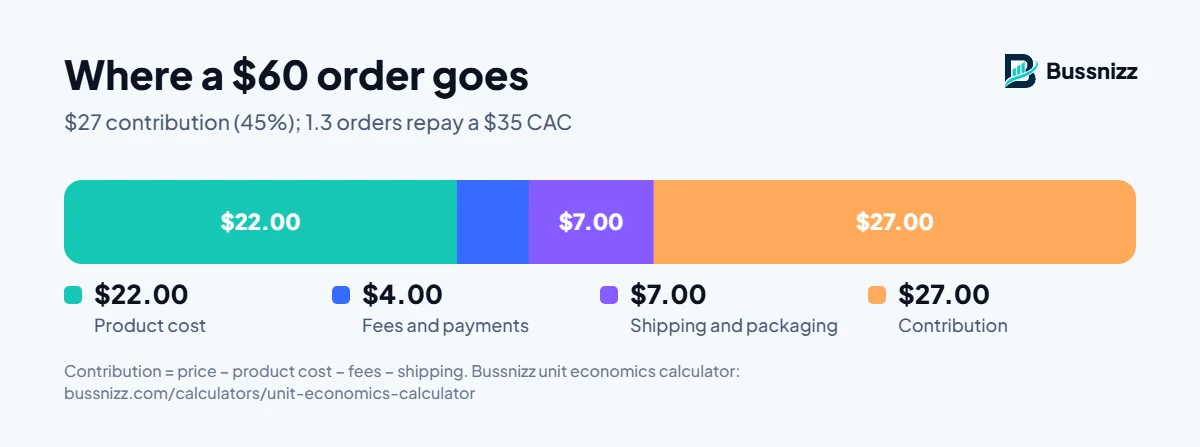
Short answer: contribution per unit = price − product cost − fees − shipping and packaging. A $60 product that costs $22, pays $4 in fees and $7 in shipping contributes $27 per order, a 45% contribution margin. If you paid $35 to win the customer, it takes 1.3 orders to pay that back. Check yours with the unit economics calculator.
What the unit economics calculator does
The unit economics calculator looks at a single order and asks whether it makes money after every per-order cost, then shows how many orders a customer must place to repay what you spent acquiring them.
How it’s calculated
- Contribution per unit = price − product cost − fees and payment processing − shipping and packaging
- Contribution margin = contribution ÷ price
- Orders to pay back CAC = customer acquisition cost ÷ contribution per unit
Fixed costs like rent and software aren’t in contribution; they’re covered by the total contribution of all your orders.
Worked example
| Line | Amount |
|---|---|
| Price | $60.00 |
| Product cost | −$22.00 |
| Fees and payment processing | −$4.00 |
| Shipping and packaging | −$7.00 |
| Contribution | $27.00 (45%) |
| Acquisition cost per customer | $35.00 |
| Orders to pay back CAC | 1.3 |
The first order alone doesn’t repay the $35, so this business needs customers to come back at least once to profit from paid ads.
Why unit economics decide whether you can scale
If contribution is negative, more sales mean bigger losses. If payback takes more orders than an average customer places (see lifetime value), ads lose money even when contribution is positive. Fix those two before scaling ad spend.
Fees are the line sellers miss
On a marketplace, “fees” can be 10% to 20% of the order. Use the platform calculators for an exact figure: Etsy, Amazon FBA, Shopify, or compare all of them in Marketplace Profit Compare.
Options in the calculator
- Price per unit, product cost, fees and payment processing, shipping and packaging, acquisition cost per customer
Why use this calculator
- The two numbers that decide scaling, contribution and payback, on one screen.
- Free and private, with a clean printable report.
- Links straight to exact fee calculators for the platform you sell on.
Conclusion
Healthy unit economics means every order contributes, and customers repay their acquisition cost within the orders they actually place. Get those right and growth becomes profitable.
Frequently asked questions
What are unit economics in ecommerce? The revenue and costs tied to a single order or customer, used to see whether each sale makes money.
What is contribution margin? Price minus all variable costs per unit, as a share of price.
What is CAC payback? How many orders, or how many months, it takes for a customer’s contribution to repay what you spent to acquire them.
What is a good contribution margin? High enough to cover fixed costs at your sales volume. Use the break-even calculator to check.
Should fixed costs be in unit economics? No. Keep them separate and cover them with total contribution.
Examples use round numbers. Use your own costs and real fee figures from your seller account.
Run the numbers yourself
Free calculators with every fee and formula shown.
 Etsy Profit CalculatorWhat you keep after Etsy's listing, transaction, processing, and Offsite Ads fees, for sellers in 7 countries.
 Amazon FBA Profit CalculatorProfit per unit on Amazon FBA after referral fees, fulfillment, storage, PPC, and your selling plan.