USPS Fuel Surcharge 2026: What Sellers Pay in 2027
The USPS fuel surcharge 2026 is 8% of base postage. On Jan 17, 2027 USPS plans 11%, plus a 5.9% average price increase. What it costs sellers and what to do.
By Sharjil Hameed · Published November 14, 2026 · 5 min read · How we fact-check
Short answer: The USPS fuel surcharge for 2026 is a temporary 8% charge on base postage for Ground Advantage, Priority Mail, Priority Mail Express and Parcel Select. On January 17, 2027, USPS plans to make it permanent at 11%, on top of a 5.9% average rate increase. Plug your new label costs into our profit margin calculator to see what changes.
On November 12, 2026, the U.S. Postal Service filed its 2027 shipping prices with the Postal Regulatory Commission (PRC). The filing turns this year’s “temporary” 8% charge into a permanent fuel surcharge and raises it to 11%. If you sell on Etsy, eBay, Amazon (FBM), Shopify or TikTok Shop and buy USPS labels, this affects every package you send next year. Here is what is changing, when, and how to adjust your prices.
What is the USPS fuel surcharge in 2026?
USPS added its first transportation-related surcharge this year. It announced the charge on March 25, 2026: an 8% increase on base postage for Priority Mail, Priority Mail Express, USPS Ground Advantage and Parcel Select. It took effect on April 26, 2026 and was scheduled to end on January 17, 2027. First-Class stamps were not affected.
On top of that, USPS added a holiday peak surcharge from October 4, 2026 to January 17, 2027. Unlike the 8% charge, the peak surcharge is a flat dollar amount that depends on the service, the zone and the package weight. For example, commercial Ground Advantage packages up to 3 lbs pay an extra $0.40 in Zones 1-4 and $0.55 in Zones 5-9.
| Commercial peak surcharge (Oct 4, 2026 to Jan 17, 2027) | 0-3 lbs | 4-10 lbs | 11-25 lbs |
|---|---|---|---|
| Ground Advantage, Zones 1-4 | $0.40 | $0.65 | $1.05 |
| Ground Advantage, Zones 5-9 | $0.55 | $1.05 | $1.75 |
| Priority Mail, Zones 1-4 | $0.40 | $0.65 | $1.05 |
| Priority Mail, Zones 5-9 | $0.85 | $1.75 | $3.85 |
Most marketplace and shipping-app labels use commercial prices. Retail prices at the post office counter have their own, higher peak amounts (for example, $0.50 for Zones 1-4 at 0-3 lbs). Both peak schedules are in USPS’s August 25, 2026 announcement.
What changes with the USPS fuel surcharge in 2027?
The November 12 filing makes three changes for domestic packages, all scheduled for January 17, 2027:
- Base prices go up 5.9% on average for Priority Mail, Priority Mail Express, Ground Advantage and Parcel Select. “Average” matters: your increase depends on the service, zone and weight.
- The 8% charge becomes a permanent fuel surcharge, plus an extra 3 percentage points because fuel prices rose further. That makes the total 11%.
- The holiday peak surcharge ends on the same day, as scheduled.
USPS says the 11% surcharge will be reviewed in July 2027 based on fuel prices in the first half of the year. It does not apply to international products for now. International prices are rising separately, by 7.9% on average for Priority Mail Express International, Priority Mail International, First-Class Package International Service and International Priority Airmail. USPS is not raising First-Class stamp prices in January.
These prices are a proposal. The PRC reviews them before they take effect, so check USPS’s Postal Explorer price tables before you change your shipping settings.
Is the USPS fuel surcharge proposal weekly or fixed?
For now, fixed. In late October, USPS described a fuel surcharge that would update weekly from diesel and jet fuel prices, as FedEx and UPS do. The November 12 announcement instead describes a single 11% rate with a review in July 2027. Industry reporting on the full filing says USPS still plans weekly adjustments later, but no start date has been announced. Plan your 2027 prices around 11%, and expect it to change at least once.
How much more will a USPS label cost? A worked example
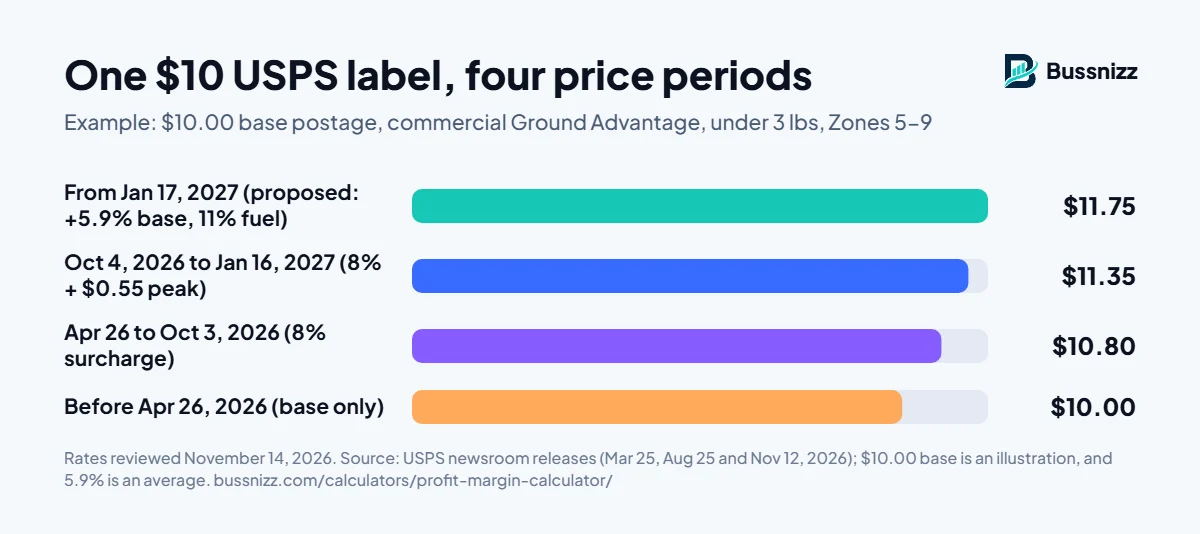
Here is a simple example. Say a package’s base postage is $10.00. This is a round number for illustration, not a real USPS rate. It is a commercial Ground Advantage package under 3 lbs going to Zone 5-9.
- Before April 26, 2026: base postage only = $10.00.
- April 26 to October 3, 2026: $10.00 + 8% ($0.80) = $10.80.
- October 4, 2026 to January 16, 2027: $10.80 + $0.55 peak surcharge = $11.35.
- From January 17, 2027 (proposed): base rises 5.9% to $10.59. Then 11% fuel surcharge ($1.16) = $11.75.
So the same package costs $1.75 more (17.5%) than it did before April. It also costs $0.40 more than today’s holiday price, even after the peak surcharge ends. Your real numbers will differ, because the 5.9% is an average and marketplace label discounts change often. Use the steps to rerun the math with your own label costs.
How do higher shipping costs affect Etsy fees?
If buyers pay for shipping, a higher shipping charge also means a higher marketplace fee. Etsy’s Fees & Payments Policy says the 6.5% transaction fee applies to the item price plus the amount you charge for delivery and gift wrapping. In the example above, if you charge the buyer the full label cost, Etsy’s transaction fee on shipping goes from $0.65 (6.5% of $10.00) to $0.76 (6.5% of $11.75). Payment processing fees are charged on top of that.
If you offer free shipping, the full increase comes out of your margin unless you raise item prices. On a thin-margin item, an extra dollar per order can be the difference between profit and break-even. Run both versions through the Etsy profit calculator or the eBay fee calculator before January 17.
What to do now
- Pull your shipping data. Find your most common package sizes, weights and zones from the last 90 days. Those few combinations drive most of your postage spend.
- Check the new price tables. Look up those combinations on USPS Postal Explorer (pe.usps.com/PriceChange/Index) and add 11% to the base price.
- Recalculate your margins. Enter the new label cost in the profit margin calculator. If you sell on more than one marketplace, compare them with the marketplace profit comparison tool.
- Update shipping profiles before January 17. Raise flat shipping rates, or build the extra cost into item prices if you offer free shipping.
- Cut weight and size. Lighter packaging can move a package into a cheaper weight tier, and the 11% surcharge is a percentage of a smaller base.
- Set a July reminder. USPS plans to review the surcharge in July 2027, so check your shipping prices again then.
Related guides
- Etsy fees explained
- eBay fees for selling
- How to calculate profit margin
- How to find your break-even point
Frequently asked questions
When does the USPS fuel surcharge 2027 start? USPS plans to start the permanent 11% fuel surcharge on January 17, 2027, the same day its 5.9% average shipping price increase takes effect. Both are subject to review by the Postal Regulatory Commission.
Which USPS services have the fuel surcharge? USPS Ground Advantage, Priority Mail, Priority Mail Express and Parcel Select. First-Class stamps and, for now, international products are not included.
Is the USPS fuel surcharge a percentage or a flat fee? It is a percentage of base postage: 8% from April 26, 2026, and a proposed 11% from January 17, 2027. The holiday peak surcharge is different: a flat dollar amount by service, zone and weight.
Will the USPS fuel surcharge change during 2027? USPS says it will reevaluate the 11% rate in July 2027 based on fuel prices in the first half of the year. Reporting on the full filing says weekly adjustments may come later, but no date has been set.
Does Etsy charge its transaction fee on shipping? Yes. Etsy’s 6.5% transaction fee applies to the item price plus the amount you charge for delivery and gift wrapping, so higher shipping charges raise the fee.
Do the stamp prices go up in January 2027? No. USPS said it is not changing First-Class Mail stamp prices in January 2027.
Sources: USPS: Shipping Price Adjustments for 2027 (Nov 12, 2026), USPS: 2026 holiday temporary price change, USPS: transportation-related price change (Mar 25, 2026), Etsy Fees & Payments Policy. Last reviewed November 14, 2026.
Run the numbers yourself
Free calculators with every fee and formula shown.
 Etsy Profit CalculatorWhat you keep after Etsy's listing, transaction, processing, and Offsite Ads fees, for sellers in 7 countries.
 Amazon FBA Profit CalculatorProfit per unit on Amazon FBA after referral fees, fulfillment, storage, PPC, and your selling plan.
 eBay Fee CalculatoreBay final value fees, the per-order fee, international and promoted listing fees, and your profit.
Profit Margin CalculatorGross profit, margin, and markup from cost and price.
Markup CalculatorSelling price from cost and markup, or from a target margin.