How to calculate your break-even point (units and sales), with examples
Your break-even point is the number of sales where you stop losing money. Here's the formula, worked examples for a product seller and a service business, and how fees change the answer.
By Sharjil Hameed · November 13, 2026 · 3 min read

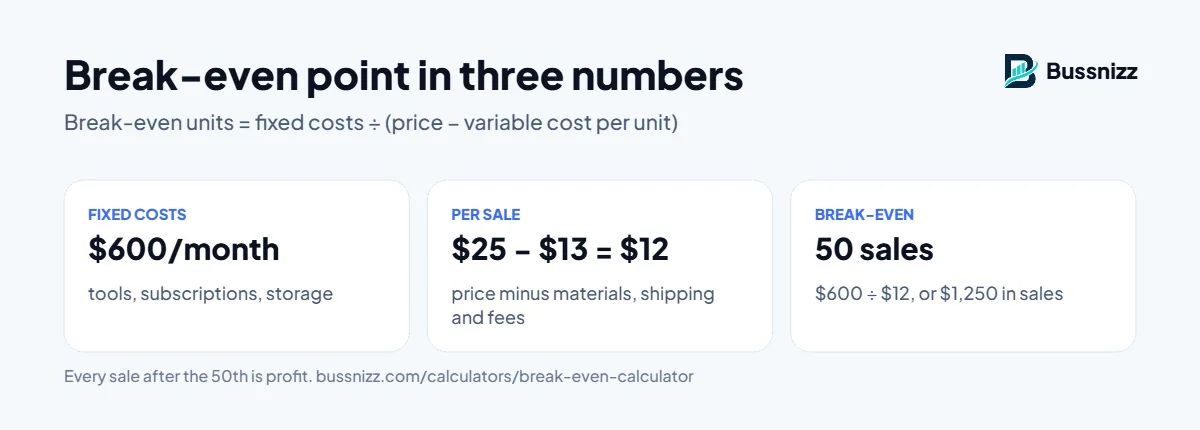
Short answer: your break-even point in units = fixed costs ÷ (price per unit − variable cost per unit). If your fixed costs are $600 a month, you sell at $25, and each sale costs you $13 in materials, fees, and shipping, you break even at $600 ÷ $12 = 50 sales a month. Every sale after the 50th is profit. Try your own numbers in the break-even calculator.
Knowing your break-even point answers the most important question in a small business: how much do I need to sell before I’m making money? It also tells you how much a price change, a fee increase, or a new monthly expense really matters.
The three numbers you need
Fixed costs
Costs you pay whatever you sell: software subscriptions, rent, insurance, a marketplace plan, your website hosting. Add them up for a month.
Price per unit
What a customer pays for one item or one service.
Variable cost per unit
Costs that come with each sale: materials, packaging, shipping, and platform and payment fees. Fees are the cost sellers most often forget. On Etsy, for example, a $25 item with $5 shipping pays about $3.30 in Etsy fees (see Etsy fees explained).
The break-even formula
Contribution margin per unit = price − variable cost per unit
This is what each sale contributes toward your fixed costs.
Break-even units = fixed costs ÷ contribution margin per unit
Break-even sales in dollars = break-even units × price, or fixed costs ÷ contribution margin ratio, where the ratio is contribution margin ÷ price.
Example 1: a product seller
- Fixed costs: $600 a month (tools, subscriptions, a storage unit)
- Price: $25
- Materials and packaging: $7
- Shipping: $3
- Platform and payment fees: $3
Variable cost per unit = $13. Contribution margin = $25 − $13 = $12.
Break-even = $600 ÷ $12 = 50 units a month, or $1,250 in sales.
If fees rose by $1 per order, the contribution margin would drop to $11 and break-even would rise to about 55 units. A small fee change means five more sales every month just to stand still.
Example 2: a freelancer or service business
- Fixed costs: $1,200 a month (software, insurance, phone)
- Price: $90 per hour
- Variable cost per hour: $5 (payment fees and per-job costs)
Contribution margin = $85. Break-even = $1,200 ÷ $85 = about 15 billable hours a month. To also pay yourself a salary, add it to fixed costs: with a $3,000 salary target, break-even is ($1,200 + $3,000) ÷ $85 = about 50 hours. Our guide to converting salary to hourly shows how to turn a salary goal into a rate.
How to lower your break-even point
- Raise your price. Even a small increase goes straight to contribution margin.
- Cut variable costs, especially fees and shipping, which you pay on every sale.
- Trim fixed costs you don’t need.
- Check your margin, not just revenue. The profit margin guide explains the difference between margin and markup.
Frequently asked questions
What is the break-even point formula? Break-even units = fixed costs ÷ (price per unit − variable cost per unit). Multiply the result by your price to get break-even sales in dollars.
What is a contribution margin? The price of one unit minus the costs that come with selling it. It’s the amount each sale contributes toward fixed costs and then profit.
Should marketplace fees be fixed or variable costs? Fees charged per sale, such as transaction, referral, and payment processing fees, are variable costs. Monthly plan or subscription fees are fixed costs.
How often should I recalculate my break-even point? Whenever your price, costs, or platform fees change, and at least once a quarter.
The examples use round numbers for clarity. Your break-even point depends on your own costs, so use the break-even calculator with your real figures.
Run the numbers yourself
Free calculators with every fee and formula shown.
 Etsy Profit CalculatorWhat you keep after Etsy's listing, transaction, processing, and Offsite Ads fees, for sellers in 7 countries.
 Amazon FBA Profit CalculatorProfit per unit on Amazon FBA after referral fees, fulfillment, storage, PPC, and your selling plan.
Salary to Hourly CalculatorConvert a yearly salary to an hourly, weekly, and monthly rate.
Mortgage CalculatorMonthly mortgage payment with principal, interest, property tax, insurance, and HOA.
Concrete CalculatorCubic yards of concrete and premix bags for a slab, footing, or patio.