eBay 1099-K: The 2026 Threshold and What to Report
eBay 1099-K rules for 2026: eBay sends the form when gross payments top $20,000 and you have more than 200 sales. Here's what it shows and how to report it.
By Sharjil Hameed · Published November 27, 2026 · 6 min read · How we fact-check

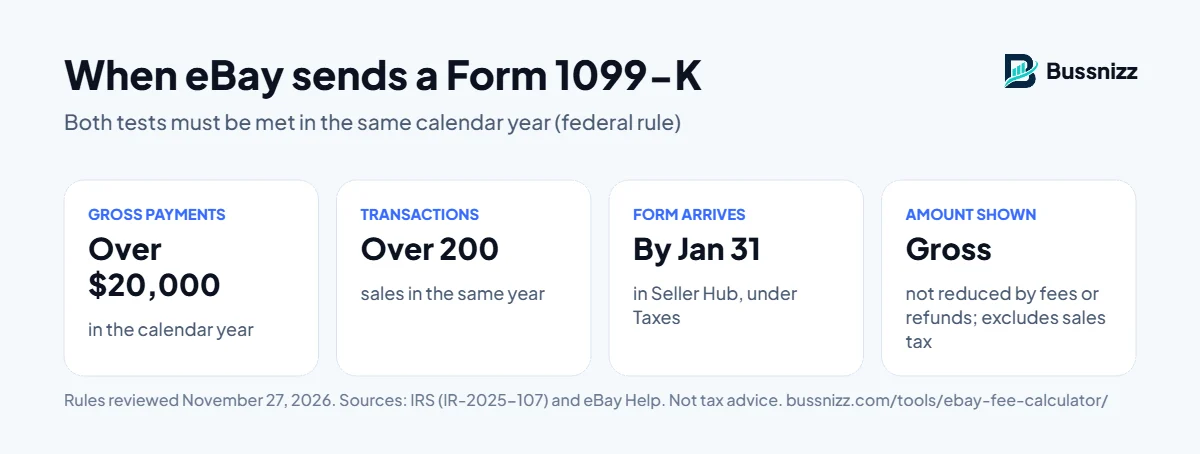
Short answer: eBay sends a Form 1099-K when your gross payments are more than $20,000 and you have more than 200 transactions in a calendar year. The form arrives in your eBay account by January 31. It shows gross sales before fees and refunds, so track your costs with an eBay fee calculator before tax time.
Holiday sales are now coming in, and every order you ship through December 31 counts toward your 2026 totals. Here is how the eBay 1099-K works, who gets one, and what to do with it. This guide explains the rules in plain words. It is not tax advice, so check your own situation with a tax professional.
What is the eBay 1099-K threshold for 2026?
The federal rule is two tests, and you must pass both. Under the One, Big, Beautiful Bill, a payment platform does not have to file a Form 1099-K unless the gross amount paid to you exceeds $20,000 and the number of transactions exceeds 200. The IRS announced this on October 23, 2025. The law brought back the threshold that applied before the American Rescue Plan Act of 2021.
eBay’s own help page lists the same two tests: gross payments over $20,000 and more than 200 transactions. eBay also issues a 1099-K to any seller whose payments had backup withholding applied, even if they are under the threshold. If you run several eBay accounts under the same tax ID, eBay combines them.
| Your 2026 eBay sales | Gross over $20,000? | Over 200 sales? | Federal 1099-K? |
|---|---|---|---|
| $24,000 from 250 orders | Yes | Yes | Yes |
| $30,000 from 150 orders | Yes | No | No |
| $12,000 from 600 orders | No | Yes | No |
| $8,000 from 90 orders | No | No | No |
Your state may have its own reporting rules, so check with your state tax agency too.
Do I owe tax if I don’t get a 1099-K from eBay?
Yes, if you made money. The 1099-K is only a reporting form. It does not decide what is taxable. The IRS says you must report all income you received during the year, whether or not you get a Form 1099-K. A seller with $15,000 in eBay sales and no form still reports the business income.
The flip side is also true. Getting a 1099-K does not mean the whole amount is taxable. What you owe depends on your profit, or on whether you sold personal items for less than you paid.
What does the eBay 1099-K amount include?
eBay says the form shows the gross amount of all reportable payments in the calendar year, based on when eBay processes the funds, not when they reach your bank. That number is not reduced by credits, discounts, fees, refunds or other adjustments. eBay does exclude sales tax and canceled transactions from the gross amount.
So the number on your form will usually be higher than what you deposited. Your seller fees, refunds and shipping labels are things you subtract on your tax return, using your own records. The IRS FAQ makes the same point: the form reports only gross payments, and you work out your deductible expenses from your records.
How do I go from my 1099-K to my profit? (worked example)
Here is an example with made-up numbers for a seller who flips thrift finds as a business. The fee figure is an example, not an eBay rate. Use the eBay fee calculator to estimate your real fees per sale.
- Form 1099-K gross: $24,000 (250 orders)
- eBay fees for the year: $3,200
- Shipping labels: $2,400
- Refunds to buyers: $600
- Cost of the items sold: $9,000
Net profit = $24,000 − $3,200 − $2,400 − $600 − $9,000 = $8,800.
In this example, the seller’s taxable business profit is $8,800, not $24,000. That gap is why records matter. If you can’t show your costs, you have no proof for the lower number. You can check your margin on the same figures with the profit margin calculator: $8,800 ÷ $24,000 is about a 36.7% net margin.
What if I only sold personal items on eBay?
Selling your old things for less than you paid is common, and the IRS treats it differently from a business.
- Sold at a loss: the loss is not deductible, but it is not taxable income either. The IRS FAQ shows one way to report it: list the sale on Form 8949 and Schedule D, enter code “L” in column (f), and enter the nondeductible loss as a positive number in column (g), so the result is $0. In the IRS example, a person sells for $700 an item that cost $1,000.
- Sold at a gain: the gain is taxable. You report it on Form 8949 and Schedule D, Capital Gains and Losses.
- Selling as a business: if you buy items to resell, or make and sell goods, the IRS FAQ points business sellers to Schedule C, Profit or Loss from Business.
Keep receipts, old order confirmations or bank records that show what you paid. Without them, it is hard to prove a personal item sold at a loss.
Where do I find my eBay 1099-K, and what if it’s wrong?
eBay issues the form by January 31 each year for the previous calendar year. So your 2026 form should be in your account by January 31, 2027. You can find it in two places:
- Seller Hub: Payments, then Taxes. You can also open “1099-K details” and select “Generate” for a detailed report.
- My eBay: Payments, then “Payment reports and taxes,” then “Form 1099-K.”
If you want a paper copy, turn off electronic delivery on your Taxes page. Make sure the name on your eBay account matches the name on your tax ID.
If the form is wrong, contact eBay, not the IRS. The IRS says it can’t correct a Form 1099-K for you. eBay asks sellers to raise concerns no later than March 30. If you can’t get a corrected form in time, the IRS says not to wait to file. It describes how to zero out an amount reported in error with matching entries on Schedule 1 (Form 1040).
What to do now
- Open your Seller Hub payments report and add up your 2026 gross sales and order count so far. Compare them to the $20,000 and 200-transaction tests.
- Download a monthly report of your eBay fees, refunds and shipping labels before year-end, while the holiday rush is fresh.
- Save proof of what you paid for inventory and for any personal items you sold.
- Run a few typical sales through the eBay fee calculator so your prices still leave profit after fees.
- Check that your eBay account name and tax ID match, so the form comes out right in January.
- If you sell on more than one site, see the eBay seller tools page and keep separate records for each platform, since each one sends its own form.
Related guides
- eBay fees for selling, explained
- eBay currency conversion fee
- How to calculate net profit
- Sales tax for online sellers
Frequently asked questions
Will eBay send me a 1099-K for 2026? Only if your gross payments are more than $20,000 and you have more than 200 transactions in 2026, or if backup withholding was applied to your payments. eBay issues the form by January 31, 2027.
Is the eBay 1099-K threshold $600? No. The One, Big, Beautiful Bill brought back the earlier rule of more than $20,000 and more than 200 transactions, and the IRS confirmed it on October 23, 2025.
Does the 1099-K amount include eBay fees? Yes, in the sense that fees are not taken out. eBay says the gross amount is not reduced by fees, refunds, credits or discounts, though sales tax and canceled transactions are excluded.
Do I have to report eBay sales under $20,000? If you made a profit, yes. The IRS says you must report all income you received, whether or not you get a Form 1099-K.
Do I pay tax on personal items I sold at a loss? No, a loss on a personal item is not taxable, and it is not deductible. If it shows up on a 1099-K, the IRS FAQ explains how to report it so it nets to $0.
Sources: IRS, Form 1099-K threshold FAQs (IR-2025-107), IRS, What to do if you receive a Form 1099-K, eBay, Form 1099-K and other US tax forms. Last reviewed November 27, 2026.
Run the numbers yourself
Free calculators with every fee and formula shown.
 Etsy Profit CalculatorWhat you keep after Etsy's listing, transaction, processing, and Offsite Ads fees, for sellers in 7 countries.
 Amazon FBA Profit CalculatorProfit per unit on Amazon FBA after referral fees, fulfillment, storage, PPC, and your selling plan.
 eBay Fee CalculatoreBay final value fees, the per-order fee, international and promoted listing fees, and your profit.
Profit Margin CalculatorGross profit, margin, and markup from cost and price.
Markup CalculatorSelling price from cost and markup, or from a target margin.