Walmart Seller Return Rate: The 2027 Item-Level Rule
Walmart's seller return rate standard is 6% or below over 60 days. From January 2027, single items with high returns can be warned or unpublished.
By Sharjil Hameed · Published November 28, 2026 · 5 min read · How we fact-check
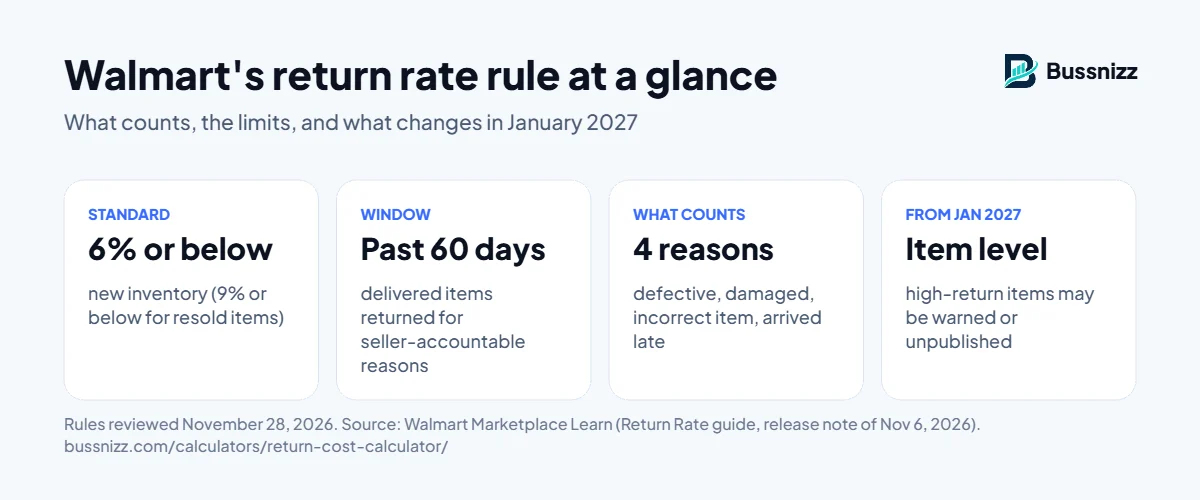
Short answer: Walmart wants your seller return rate at 6% or below (9% for resold items), counting delivered items returned for seller-caused reasons over the past 60 days. Starting in January 2027, single items with high returns can get a warning or be unpublished, even if your overall rate passes. Use our return cost calculator to see what each return costs you.
What is changing with Walmart’s return rate in 2027?
On November 6, 2026, Walmart Marketplace posted a release note titled “Prepare for item-level Return Rate enforcement.” It says that beginning in January 2027, items with high rates of seller-accountable returns may receive a warning or be temporarily unpublished, even if your overall Return Rate meets the Seller Performance Standard.
Until now, the Return Rate was mainly an account-level number. You either passed the 6% standard or you didn’t. The new rule adds a second layer: Walmart will also show a Return Rate for each item, and it can act on a single listing instead of your whole catalog.
That cuts both ways. A good account can still lose a problem SKU during a busy week. A weak item no longer has to drag down every other listing you have. Walmart has not published an exact item-level threshold or a specific day in January, so watch Seller Center for the launch notice.
How does Walmart calculate the seller return rate?
Walmart’s Return Rate guide (last updated November 6, 2026) defines it as the percentage of delivered items returned for seller-accountable reasons within the past 60 days. The standards are:
- New inventory: 6% or below.
- Resold inventory: 9% or below.
Seller-accountable means the return came from something in your control. Walmart lists four drivers:
- Defective: the item doesn’t work as it should.
- Damaged: it arrived broken, often a packaging problem.
- Incorrect item: wrong item, size, color or a listing that didn’t match.
- Arrived late: it came after the promised delivery date.
A customer who simply changed their mind is not a seller-accountable return. That matters a lot in December, when many buyers return gifts they didn’t want.
If you use Walmart Fulfillment Services (WFS), Walmart says most performance metrics, including the Return Rate, are met for you.
Worked example: does this item pass the 6% standard?
Here is an example with made-up shop numbers to show the arithmetic. Say one of your items, a ceramic planter, had 400 units delivered in the last 60 days. Buyers returned 41 units. Of those, 11 were “changed my mind” returns, and 30 were seller-accountable (18 damaged, 9 not as described, 3 late).
- Seller-accountable returns: 18 + 9 + 3 = 30
- Return rate: 30 ÷ 400 = 0.075 = 7.5%
- To reach 6%: 400 × 0.06 = 24 returns or fewer
So this item needs 6 fewer seller-caused returns over the same volume. Better packaging alone could cover most of that, since damage is the biggest share.
Now the money side. Say the planter sells for $40, it’s in Walmart’s Home, Kitchen, Decor and Garden category (a 15% referral fee on Walmart’s pricing page), and each damaged return costs you $9 in return shipping plus the $14 item you can’t resell. That’s $23 per damaged return before any referral fee question. Eighteen damaged returns cost about $414 in 60 days (18 × $23). Check whether your referral fee comes back on returns in your Seller Center payment reports, and plug your own numbers into the return cost calculator.
What are the other Walmart seller performance standards?
Return Rate is one of several metrics. Walmart’s Seller Performance Standards page (last updated July 28, 2026) lists these targets, measured over the last 30 or 60 days:
| Metric | Walmart standard | What it measures |
|---|---|---|
| Return Rate | 6% or below (9% resold) | Delivered items returned for seller-accountable reasons, past 60 days |
| On-Time Delivery Rate | 90% or above | Orders delivered on or before the expected delivery date |
| Valid Tracking Rate | 99% or above | Orders with valid tracking |
| Cancellation Rate | 2% or below | Orders the seller canceled |
| Negative Feedback Rate | 2% or below | Orders with a one- or two-star rating, past 60 days |
| Item Not Received Rate | 2% or below | Orders not delivered by the expected date, past 60 days |
| Late Shipment Rate | 5% or below | Orders shipped after the expected ship date |
| Seller Response Rate | 95% or above | Customer messages answered within 48 hours |
Walmart notifies sellers by email and in Seller Center when they miss a standard. If you don’t fix it, Walmart says that may result in suppression, suspension or termination. A separate release note on November 12, 2026 also says Walmart can terminate accounts that stay suspended beyond a reasonable threshold without a successful appeal or reinstatement.
Can a Walmart seller account get suspended for returns?
Yes. Return Rate is part of the Seller Performance Standards, and missing those standards can lead to suppression, suspension or termination. The January 2027 change gives Walmart a softer first step: it can warn about or unpublish only the problem item.
The practical takeaway: an unpublished item during a sales window is lost revenue, even if your account is safe. Treat item-level warnings as a reason to fix that listing quickly, not as background noise.
How do you lower your Walmart return rate?
Go after the four seller-accountable reasons one by one:
- Damaged: test your packaging with a drop test, add corner protection and void fill, and ship fragile items in double boxes.
- Incorrect item or not as described: check that photos, size charts, colors and materials match what ships. Add measurements in inches to the title or key features.
- Defective: pull a sample from each new batch from your supplier before listing it.
- Arrived late: set realistic handling times and use carriers that meet your promised dates. Late deliveries also hurt your On-Time Delivery Rate.
Also price returns into your product. If an item’s return costs eat its margin, check the item’s real profit with the Walmart profit calculator before you restock it.
What to do now
- Open the Returns page in Seller Center and use “View returns insight” to see each item’s Return Rate, units returned and top return reasons.
- Sort items by Return Rate and list every item above 6% (9% for resold).
- For each one, find the top seller-accountable reason: damaged, defective, incorrect or late.
- Fix the biggest cause first: packaging for damage, listing details for “not as described,” supplier checks for defects.
- Work out the cost of returns per item with the return cost calculator and the Walmart profit calculator. Drop or reprice items that lose money after returns.
- Check again in mid-December so your 60-day window looks clean before January 2027.
Related guides
- Walmart seller fees explained
- The real cost of returns for online sellers
- Holiday return policies for 2026
- Unit economics for ecommerce
Frequently asked questions
What is a good return rate for Walmart sellers? Walmart’s standard is 6% or below for new items and 9% or below for resold items. It only counts returns for seller-accountable reasons over the past 60 days.
Do “changed my mind” returns count toward my Walmart return rate? No. Walmart’s Return Rate counts returns tied to things in the seller’s control: defective, damaged, incorrect or late items.
When does Walmart’s item-level return rate enforcement start? Walmart says it begins in January 2027. It has not named an exact day, so watch Seller Center for notices.
What happens if one item has a high return rate? From January 2027, that item may get a warning or be temporarily unpublished, even if your overall account Return Rate meets the standard.
Does WFS help with the return rate? Walmart says most performance metrics, including the Return Rate, are met for you if you use Walmart Fulfillment Services.
Sources: Walmart Marketplace release notes, Walmart Return Rate guide, Walmart Seller Performance Standards, Walmart Marketplace pricing. Last reviewed November 28, 2026.
Run the numbers yourself
Free calculators with every fee and formula shown.
 Etsy Profit CalculatorWhat you keep after Etsy's listing, transaction, processing, and Offsite Ads fees, for sellers in 7 countries.
 Amazon FBA Profit CalculatorProfit per unit on Amazon FBA after referral fees, fulfillment, storage, PPC, and your selling plan.
 eBay Fee CalculatoreBay final value fees, the per-order fee, international and promoted listing fees, and your profit.
Profit Margin CalculatorGross profit, margin, and markup from cost and price.
Markup CalculatorSelling price from cost and markup, or from a target margin.